Flowmeters 101 – Magnetic and Coriolis Flowmeter
Flowmeters play a vital role in sanitary processing. They are used to measure incoming raw materials, incoming water supply, CIP solutions, ingredients in your formulation, final product production and even waste water leaving the plant. Considering their use in critical applications, ensuring that you are using the right type of meter with the correct level of accuracy for your application can be the difference in the quality of your product and save you thousands of dollars in lost revenue or profit.
In sanitary processing, one will typically find mechanical flowmeters (Positive Displacement, Turbine), electromagnetic
and Coriolis flowmeters.
Magnetic Flowmeters
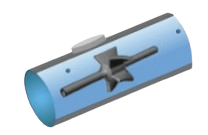
Magnetic flowmeters use Faraday’s Law of Electromagnetic Induction to determine the
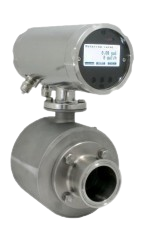
flow of liquid through a pipe. This type of flowmeter works by generating a magnetic
field and channeling that through the liquid in the pipe. Faraday’s Law states that flow of
a conductive liquid through the magnetic field will cause a voltage signal that can be
sensed by electrodes on the tube walls. When the fluid moves faster, more voltage is
generated. The voltage generated is proportional to the movement of the liquid.
Transmitters process the voltage signal to determine liquid flow.
The signals produced by the voltage are linear with the flow. With this, the turndown
ratio is very good without sacrificing accuracy.
Pros and Cons
Since these flowmeters measure conductivity, obviously the fluids measured need to be conductive – water, acids and
bases. Low conductive liquids, such as deionized water or gases, can cause the flowmeter to turn off and/or measure
zero flow. There is no obstruction in the path of the liquid, therefore no induced pressure drop across the meter. One
other benefit of mag meters is that they can be used on gravity-fed liquids. With gravity-fed liquids, make sure the
orientation of the flowmeter is vertical so that the flowmeter is completely filled with liquid. These flow meters are
sensitive to air bubbles because the meter cannot distinguish entrapped air from the liquid. Air bubbles will cause the
meter to read high.
Mag meters are typically chosen because they have no obstructions, are cost-effective and provide highly accurate
volumetric flow. Additionally, they can handle flow in either direction and are effective at low and high volume rates.
Coriolis Mass Flowmeters
A Coriolis mass flowmeter operation is based on the principles of motion mechanics. This flowmeter contains a vibrating
tube in which a fluid flow changes in frequency and amplitude. As fluid moves through this tube, it is forced to
accelerate toward the point of peak amplitude vibration. Conversely, a decelerating fluid moves away from the point of
peak amplitude as it exits the tube. The result is a twisting reaction of the tube as flow moves through it. The amount
of twist is proportional to the real mass flow of fluid passing through the tube.
This effect can be experienced when
riding a merry-go-round – when moving
toward the center, a person will “lean
into” the rotation to maintain balance.
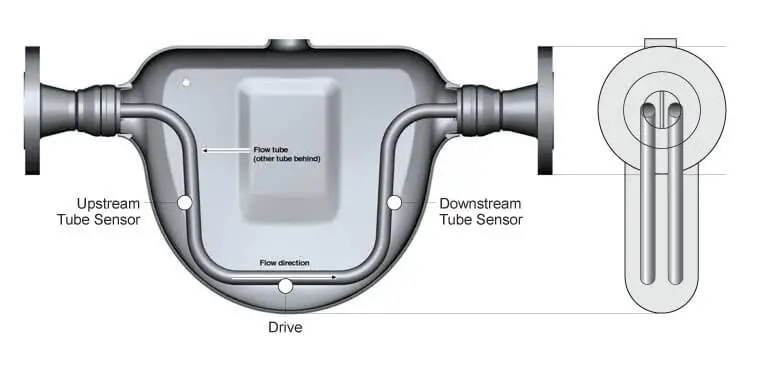
Most flowmeters have a split coil design.
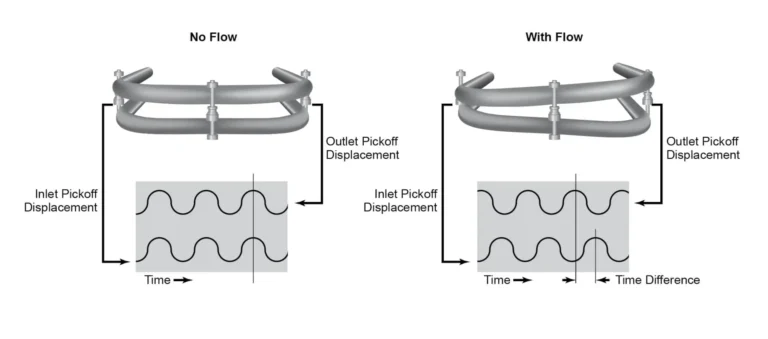
During operation, a drive coil stimulates
the tubes to oscillate in opposition (sine
waves). A sensor measures the time
delay between the two sine waves
(Delta T) which is directly proportional to
mass flow rate.
Pros and Cons
These flowmeters are used in a wide range of critical and challenging applications. They can handle low to high flow
rates with very high accuracy. They are highly reliable and have minimal calibration requirements and low maintenance
costs. In addition, fluid density has basically no impact on flow measurement which makes Coriolis meters ideal where
the physical properties are unknown. They have a higher initial cost than other flowmeters. Pressure drop must also be
considered, especially if running high viscosity fluids.
spins proportionally faster.