Flowmeters 101 – Turbine and PD meters
Flowmeters play a vital role in sanitary processing. They are used to measure incoming raw materials, incoming water
supply, CIP solutions, ingredients in your formulation, final product production and even waste water leaving the plant.
Considering their use in critical applications, ensuring that you are using the right type of meter with the correct level of
accuracy for your application can be the difference in the quality of your product and save you thousands of dollars in
lost revenue or profit.
Before we begin, let’s cover a few basics of flow. Both gas and liquid flow can be measured in volumetric or mass flow
rates such as gallons per minute or pounds per minute, respectively. These measurements are related to each other by
the density of the product. In engineering terms, the volumetric flow rate is usually given the symbol 𝑸 and the mass
flow rate is given the symbol ṁ. For a fluid having a density 𝝆, mass and volumetric flow rates are related by ṁ = 𝝆 ∗ 𝑸.
In sanitary processing, one will typically find mechanical flowmeters (Positive Displacement, Turbine), electromagnetic
and Coriolis flowmeters.
Turbine Flowmeters
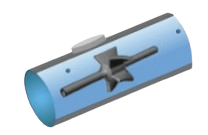
Turbine flowmeters use the mechanical energy of the fluid to rotate a “pinwheel”
(rotor) in the flow stream. Blades on the rotor are angled to transform energy from
the flow stream into rotational energy. The rotor shaft spins on bearings. When the
fluid moves faster, the rotor spins proportionally faster.
Shaft rotation can be sensed mechanically or by detecting the movement of the
blades. Blade movement is often detected magnetically, with each blade or embedded piece of metal generating a
pulse. Turbine flowmeter sensors are typically located external to the flowing stream to avoid material of construction
constraints that would result if wetted sensors were used. When the fluid moves faster, more pulses are generated. The
transmitter processes the pulse signal to determine the flow of the fluid. Transmitters and sensing systems are available
to sense flow in both the forward and reverse flow directions.
Pros and Cons
Turbine flowmeters have a moderate cost and work well in clean, low viscosity fluids at a moderate, steady velocity.
They do create some pressure drop. Bearings do wear out over time and accuracy will diminish and eventually fail as the
bearings wear. Turbine flowmeters also typically work best in a limited temperature ranges. These meters are less
accurate at low flow rates due to bearing/rotor drag.
Positive Displacement Flowmeters
Positive displacement flowmeter technology is the only flow measurement technology that directly measures the
volume of the fluid passing through the flowmeter. Positive displacement flowmeters achieve this by repeatedly
entrapping fluid in order to measure its flow. This process can be thought of as repeatedly filling a bucket with fluid
before dumping the contents downstream. The number of times that the bucket is filled and emptied is indicative of the
flow through the flowmeter. Many positive displacement flowmeter geometries are available.
PD flowmeters have the same basic mechanism as a PD pump. Rotors turn to move a fixed amount of liquid through the
body of the flowmeter. In most designs, the rotating parts have tight tolerances so these seals can prevent fluid from
going through the flowmeter without being measured (slippage). Rotation can be sensed mechanically or by detecting
the movement of a rotating part. When more fluid is flowing, the rotating parts turn proportionally faster. The
transmitter processes the signal generated by the rotation to determine the flow of the fluid.
Pros and Cons
One of the main benefits of using a PD flow meter is the high level of accuracy that they offer, the high precision of
internal components means that clearances between sealing faces is kept to a minimum. The smaller these clearances
are, relates to how high the accuracy will be.
Another benefit is the flow meters ability to process a huge range of viscosities and it is not uncommon to experience
higher levels of accuracy while processing high viscosity fluids, simply due to the reduction of slippage. When
considering and comparing flow meter accuracy, it is important to be aware of both ‘linearity’ i.e. the flow meters ability
to accurately measure over the complete turndown ratio, and ‘repeatability’, the ability to remain accurate over a
number to cycles. This is another area where PD flow meters excel, repeatability of 0.02% and 0.5% linearity are
standard.
Similar to a PD pump, PD flowmeters are considered to have low maintenance requirements. The moving parts will
wear over time and require maintenance and calibration. They should not be used for products that contain large
particles. Another factor to consider is the pressure drop caused by the PD flow meter; although these are minimal,
they should also be allowed for in system calculations.