Mixing Basics 101

In basic terms, mixing is simply defined as blending two or more materials into one single product.  The individual components, each with their distinct properties (composition, temperature, density, etc) are considered “mixed” when the final product reaches the maximum state of uniformity and all individual differences (temperature, density, etc) have been eliminated.     Mixing is a critical process because the quality of the final product and its attributes are derived by the quality of the mix. Improper mixing results in a non-homogenous product that lacks consistency with respect to desired attributes like chemical composition, color, texture, flavor, reactivity, and particle size.

How a Mixer Works

The principal behind a mixer is to provide an adequate amount of power to mix the products efficiently.   The motor is the driving force that provides the power to drive and turn the shaft.  The bearing frame provides support for the motor, coupling and shaft.  In sanitary processing applications, the motor, housings and shaft are typically made of 316L stainless.  This provides greater corrosion resistance and allows for complete wash-down during cleaning.

At the end of the shaft is the impeller or rotor.  To increase mixing and pumping in a tank, several impellers may be arranged on a single shaft.  The combination of the speed of the shaft rotation and the orientation and type of blade pumps the liquid to provide mixing or flow of the product.

Impellers are classified into two types, axial and radial, depending on the angle that the impeller (also known as agitator) blade makes with the plane of impeller rotation.  All impellers produce both fluid velocity and fluid shear, but different types of impellers produce different degrees of flow and turbulence.

Shear

Shear is a mechanical force that deforms or cuts a material between two blades.   The term ‘Velocity head’ is interchangeable with shear in mixing terms. A high-shear mixer can be used to create emulsions, suspensions or dissolve granular products.  They are commonly used for powders that tend to float on water, form “fish eyes”, or granules that require particle size reduction.

A rotor/stator mixer is a common high-shear mixer used in sanitary processing.  The rotor is a rotating impeller that rotates at a high speed to move the product from the inside to the outside through the stator.  The stator is the stationary cage or shell with very close clearance to the rotor.  A high-shear area is formed as the product is forced through the small clearances between the rotor and stator.  This action reduces particle size and increases surface area for better wetting and/or dispersion.

Static mixers are not commonly found in sanitary processing but offer a low-energy mixing alternative for liquids that are easily miscible.  It is used for continuous processing applications in which a tube or housing is fitted with baffles.   The baffles may be constructed of stainless steel, Teflon®, PVC or other material.

As the product streams move through the tube, the baffles create a turbulent flow pattern.   These mixers provide a uniform mixing option that is quick, economical and has no moving parts.

Impellers are classified into two types, axial and radial, depending on the angle that the impeller (also known as agitator) blade makes with the plane of impeller rotation.  All impellers produce both fluid velocity and fluid shear, but different types of impellers produce different degrees of flow and turbulence.

  • Axial Flow Impellers:The impeller blade makes an angle of less than 90° with the plane of impeller rotation. As a result the locus of flow occurs along the axis of the impeller (parallel to the impeller shaft) – e.g.: Marine Propellers, Pitched Blade Turbine


  • Radial Flow Impellers:The impeller blade in radial flow impellers is parallel to the axis of the impeller. The flow draws from above and below the impeller and discharges it toward the tank wall (perpendicular to the impeller shaft) – e.g.: Flat Blade Turbine, Paddle, Anchor


Baffles: Long strips or flat blades attached to the inside tank wall either directly or on tabs.  Baffles create turbulence and reduce vortexing or swirling.  Baffles are recommended within tanks or kettles where the material is water-like or has a viscosity less than 500 cps.

Without baffles, a center vortex can form in the tank, and as a result, the liquid simply rotates around the vessel with very poor mixing between adjacent fluid levels.  Swirling is not mixing.  A vortex is normally not desired as it can increase the amount of air entrapped in the fluid.

In a situation where solids or powders must be mixed into a fluid, full baffles are not recommended.

What are the Benefits of Pump Repair Training?

A pump is simply defined as a device that raises, transfers, delivers, or compresses fluids or that attenuates gases especially by suction or pressure or both. Pressure, friction and flow are three important characteristics of a pump system. Pressure is the driving force responsible for the movement of the fluid. Friction is the force that slows down fluid particles. Flow rate is the amount of volume that is displaced per unit time. Pumps are typically classified by the way they move fluids. For the sanitary industry, we will only focus on positive displacement pumps and centrifugal (or rotodynamic) pumps. Positive displacement pumps include single and double rotary lobe pumps and diaphragm pumps.

Pump Rebuild

Pump rebuilds can be performed by M.G. Newell in any of our 3 locations – Greensboro, Louisville or Nashville. As a SPX Certified Repair Center, M.G. Newell has qualified factory service technicians on staff with over 30 years of experience. We have invested in equipment, inventory and training to become one of a select group of distributors that are approved.

In a rebuild, we pull the shafts, replace the bearings and all wear items. Depending on the amount of wear, we also replace the rotors. Our shop will perform an evaluation of the pump and provide you with an estimate to rebuild your pump. The cost of a rebuild is approximately 50% of the cost of a new pump. The only drawback to a pump rebuild is a slight loss in its original efficiency.

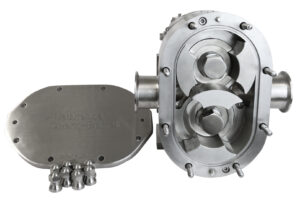
Pump remanufacture is performed by SPX Flow at their factory. In this program, they only reuse four parts: the SS cover, body, gear case and gear cover. The remaining components (see photo) are completely replaced with new, original equipment parts manufactured to factory specifications. They bore the existing body and make new oversized rotors. This machining is the main difference between a rebuild and remanufacture. When complete, the pump is back to its original performance specifications and has a new 1-year warranty from SPX Flow. Due to the new oversized body, standard rotors should not be used due to potential damage or failure of the pump. A pump can be remanufactured two times in its lifetime. The cost of a remanufactured pump is approximately 75% of the cost of a new pump.

A customer faced issues with positive displacement pumps requiring frequent and costly repairs. The problem was due to a change in personnel over the last 3-6 months, causing inefficiencies and expenses. A refresher training course was recommended to ensure proper assembly and preventive maintenance requirements. M.G. Newell conducted educational seminars at the plant, providing hands-on training classes to improve pump maintenance. This led to reduced breakdowns, lower maintenance costs, and increased production operating time.

Regular training programs and PM plans are crucial for maintaining smooth, safe, and cost-effective operations. M.G. Newell and equipment manufacturers offer plant audits and training programs to help customers maintain their equipment and reduce costs.


Pump Overview

A pump is simply defined as a device that raises, transfers, delivers, or compresses fluids or that attenuates gases especially by suction or pressure or both. Pressure, friction and flow are three important characteristics of a pump system. Pressure is the driving force responsible for the movement of the fluid. Friction is the force that slows down fluid particles. Flow rate is the amount of volume that is displaced per unit time. Pumps are typically classified by the way they move fluids. For the sanitary industry, we will only focus on positive displacement pumps and centrifugal (or rotodynamic) pumps. Positive displacement pumps include single and double rotary lobe pumps and diaphragm pumps.

Positive Displacement Pump

Positive displacement pumps are constant flow machines that force a fixed fluid volume into the discharge pipe, producing the same flow regardless of pressure. They require safety valves and small clearances to minimize leakage and operate at slow speeds to prevent erosion and wear.

When would you choose a PD pump? Typically, PD pumps are selected for the following scenarios:

High Viscosity Products
(up to 1,000,000+ cps)

  • As viscosity increases, flow actually increases. This is
    because the higher viscosity liquids fill the clearances of the pump causing a higher volumetric efficiency.

Variable Viscosities

  • Many liquids vary in viscosity depending on temperature or due to chemical reaction. A rise in viscosity will independently alter the flow rate and efficiency. Add to that the rise in pressure due to the increase in frictional line losses and PD pumps become the clear choice for variable viscosity applications.

Metered Flow

  • A fixed volume of liquid is moved per revolution of a PD pump. Flow quantity can easily be metered by adjusting the speed of the pump.

High Pressure Conditions
(up to 500 psi)

  • Pressure limits will depend on the design of each pump, but pressures of 250 psi (580 feet) are not unusual for a PD pump, with some models going over 3,000 psi (7,000 feet).

Materials with Particulates 

  • Due to its gentle pumping action, PD pumps are able to handle particulates with minimal damage to the product.

Shear Sensitive Products

  • Generally speaking, pumps tend to shear liquids more as speed is increased and centrifugals are high speed pumps. This makes PD pumps better able to handle shear sensitive liquids.

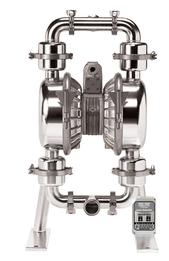
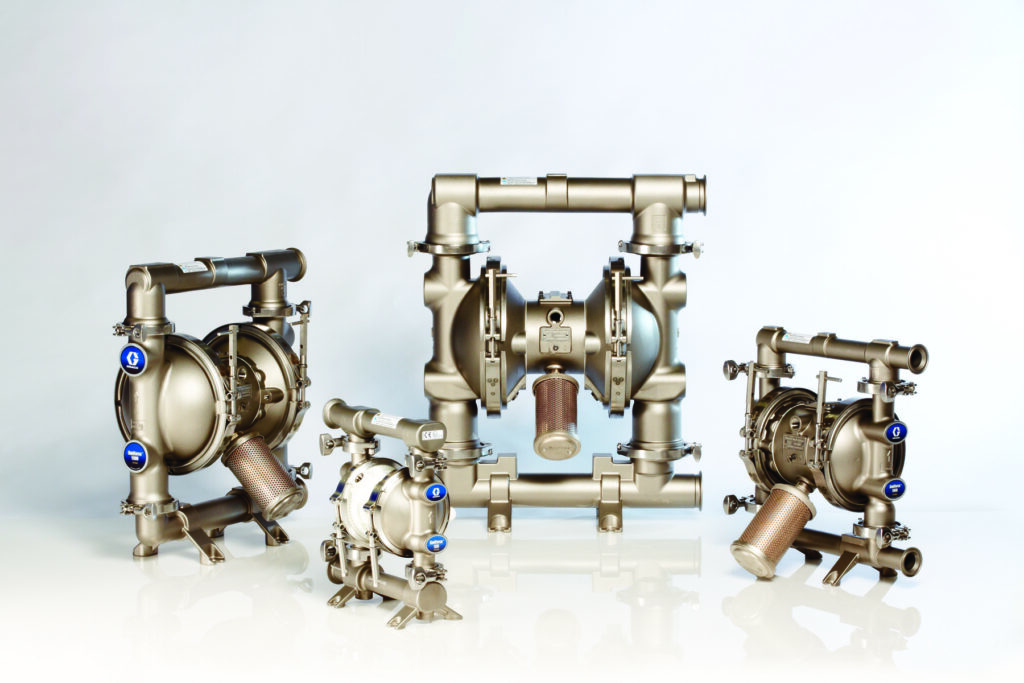
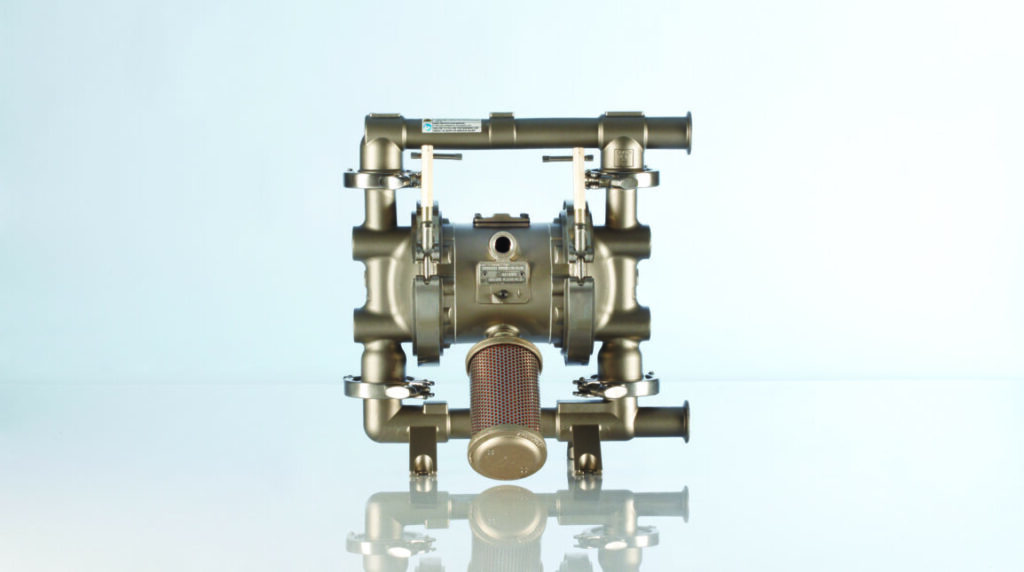
A diaphragm pump is a positive displacement pump using a rubber, thermoplastic, or Teflon® diaphragm and valves to pump fluid. It has two air chambers, air valves, fluid housing, inlet and discharge manifolds, diaphragms, shaft, mufflers, and exhaust port, delivering specific flow per stroke or cycle.

Air Chambers: The pump has two chambers, one on the left side and the other on the right side of it. These
chambers let the compressed air flow in and out of it.

Air Valve: The compressed air is directed to air chambers with the help of air valves. These have a valve cup and a valve plate. Air valves make sure that the compressed air enters the air chambers and leave from it through the exhaust port.

Check Valve: There are four fluid check valves in a double diaphragm pumps. Two of them are inlet check valves while the other two are outlet check valves. The flow of liquid in the fluid housing and manifolds is controlled by these check valves.

Fluid Housing: Each pump has fluid housing, one at each side of the pump. As the name implies, fluid housing is that part which holds the fluid and makes it flow through the pumping mechanism.

Inlet Manifold: Fluid enters the pumping container via the inlet manifold and flows evenly to the left and right fluid housing. This mechanism makes the distribution of fluid equal so that both fluid housings remain in operation.

Outlet or Discharge Manifold: When the fluid is coming out of the container, it passes through a couple of components. First, the fluid passes through one of the exit check valves and then this check valve directs the fluid to the outlet manifold to finally exit the container altogether.

Diaphragms: The air operated double diaphragm pump obviously has two diaphragms in it. The diaphragm is actually a kind of a separation sheet in between the air chambers and fluid housings. The diaphragms are good enough to adjust themselves according to the rise or fall of the air pressure, as the condition may be. Besides, the two diaphragms are allied with a shaft.

Muffler: The objective of muffler is to control noise of the exhaust air. There are multiple mufflers available that offer several levels of noise reduction to ensure effective and efficient pumping operation.

Exhaust Port: The exhaust port is the final exit point in the pump.


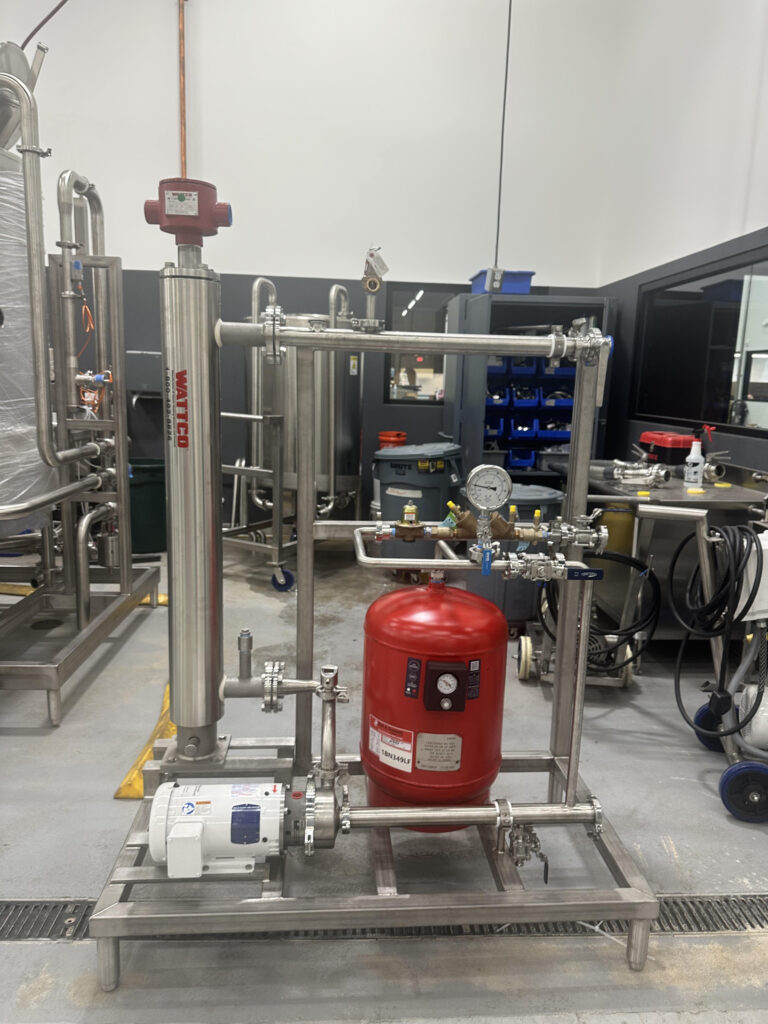
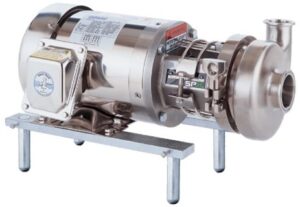
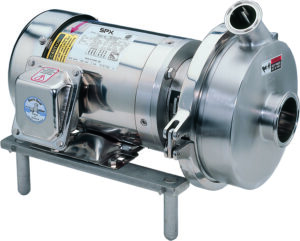
A centrifugal pump is a rotodynamic pump with a rotating impeller, used for liquid movement. It comprises a casing, impeller, shaft, bearings, and seals, with the impeller providing acceleration and the shaft rotating at motor speed.

Casing – also known as the volute, is the outside visible part of the pump. For sanitary processing, the casing is typically a heavy-walled 316L stainless configured in a spiral design to even out flow and minimize turbulence. The end cover is clamped on and can be easily removed for access to the impeller.

Impeller – The impeller is the main rotating part that provides the centrifugal acceleration of the product. The impeller can have an open or closed vane. Generally closed vane impellers develop higher pressures but have a lower capacity. Open vane
impellers develop lower pressure but have a higher capacity. It is attached to the shaft and rotates inside the casing at the speed of the shaft. The design is balanced to prevent vibration.

Shaft – The shaft rotates insides the casing at the speed of the motor and transfers the torque from the motor to the impeller. The shaft is typically made of 316L stainless.

Bearings – The bearings support the shaft and keep it in alignment so that it does not wobble inside the casing and prevents it from touching the casing.

Seals and/or Packing – The seals are the essential area in terms of hygiene as they prevent the product from leaking back inside the pump or outside of the pump when it is under pressure. Pumps can have either single-seal or double-seal arrangements.

Centrifugal 

Flow Rate and Pressure: Has varying flow rate depending on the system pressure or head.

Viscosity: Flow is reduced when the viscosity is
increased.

Efficiency: Changing the system pressure or head
dramatically effects the flow rate.

Net Positive Suction Head (NPSH): NPSH varies as a function of flow determined by pressure.

Positive Displacement 

Flow Rate and Pressure: Has nearly constant flow regardless of the system pressure or head.

Viscosity: Flow is increased when the viscosity is
increased.

Efficiency: Changing the system pressure or head has
little to no effect on flow rate. 

Net Positive Suction Head (NPSH): NPSH varies as a function of flow determined by speed. Reducing the speed reduces the NPSH. 

 How Does an Air Operated (Double) Diaphragm Pump Work?

1. Chambers are filled with fluid and then emptied through an ongoing process. This is done through inlet and outlet manifolds.

2. The shaft joining the left and right diaphragms in each chamber enables them to move to and fro continuously.

3. Compressed air is directed to one of the diaphragms.

4. Eventually as the suction stoke occurs, the lower ball valve opens and the top one closes. Simultaneously, fluid enters the chamber through the inlet manifold.

5. When air enters the other diaphragm, the top ball valve opens and the lower one is closed. This allows the fluid to exit through the outlet manifold.

6. The same process repeats with the other chamber and it goes in cycles between the two chambers.

Day in the Life of a Welder

From planning and design to implementation and start-up, a project engineer does it all!

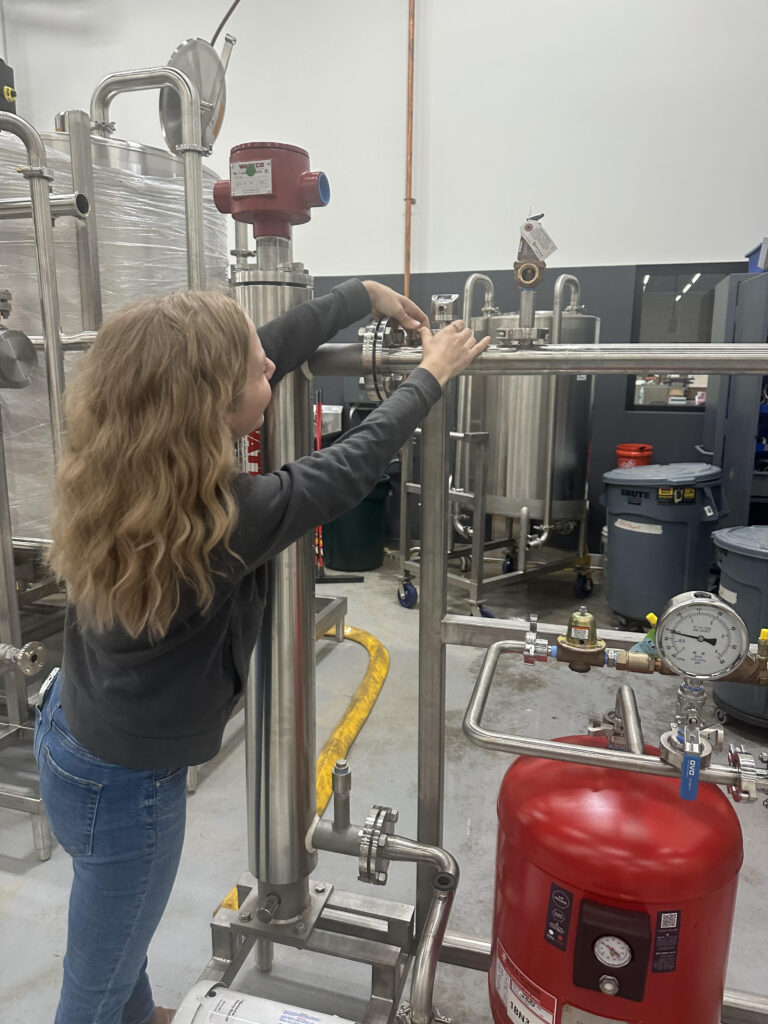
Take a look behind the scenes of a day in the life of Julia, our project engineer at M.G. Newell. 

What is a typical day for a project engineer at M.G. Newell?

“Typical” doesn’t really exist as a project engineer. One day you could be sitting at your desk the whole day working on updating drawings, and then the next you’re driving four hours roundtrip for a site visit to quote a new job, or you might have a lunch and learn with a vendor mixed with checking your materials and equipment for an upcoming job on another day. That’s what keeps things interesting, along with no two jobs being the same.

How long have you been a project engineer at M.G. Newell, and what education or background did you have to have to get this job?

I’ve been a project engineer here for a year and a half, and before this I was a corporate R&D engineer at Conagra and then at Syngenta, working on scale-up and manufacturing support of new products. Before that I received my master’s in Ag & Bio Engineering and my bachelor’s in Bio Systems Engineering (go Huskers and Boilermakers!).

What is your favorite thing about your job?

I love constantly learning new things and being challenged, however cliché that might sound. Since every job and customer is different, there’s always some unique challenge or learning curve. The people here that I get to work with are also a big plus!

If someone is interested in becoming a project engineer, what is one piece of advice you’d give them?

Never stop learning or asking questions—the work can be stressful at times, but go easy on yourself when you make mistakes because you will, and that’s okay as long as you learn from them.